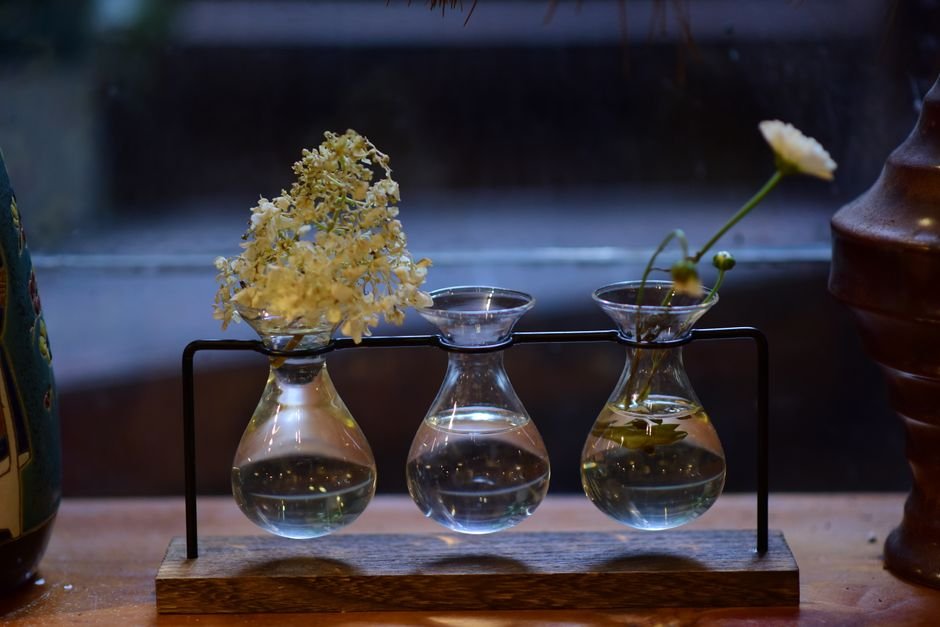
For about two years I thought I was taking decent care of my flowers because I topped up the vase whenever the water level dropped. That’s it. That was my whole system. Then one week I left for four days, came back to find the water cloudy and faintly sour smelling, and realized topping up had never actually been changing the water at all. I had just been diluting whatever was already going bad in there.
Once I started doing a full change, not a top up, the difference was obvious enough that I felt a little embarrassed it took me that long to notice.
What a full change actually means
A full change means the vase gets emptied out completely, rinsed, and refilled with fresh water, not just poured into until it reaches the old waterline again. Topping up leaves behind whatever bacteria and stem residue has built up at the bottom, and every day that mix sits there it gets a little worse. The water starts to look faintly yellow before it starts to smell, and by the time you can smell it the stems have usually already started struggling.
I now do a full change every two to three days for most mixed bunches, and I know that sounds fussy for someone who mostly buys flowers instead of growing them, but it takes maybe ninety seconds and it is the single change that has done the most for how long things last on my counter.
The stems matter as much as the water
Changing the water without recutting the stems is only half the job, and I learned this the slow way. Cut ends seal themselves within a day or two, forming a kind of callous that stops them from drinking properly even if the water around them is perfectly clean. So every time I change the water I also trim a small amount off the bottom of each stem, usually less than an inch, at an angle. I do this under running water when I remember, which is not always, and I have not noticed a huge difference whether I remember or not, honestly. The recut itself seems to matter more than the exact conditions I do it under.
Cloudy water is not always a crisis
I used to panic a little at the first sign of cloudiness and assume the whole arrangement was doomed. It usually isn’t. Slightly cloudy water after two days just means it is time for a change, not that anything has gone catastrophically wrong. What actually signals trouble is a smell, a slimy feel on the stems when you pull them out, or water that has gone properly murky rather than just slightly hazy. I’ve fished out stems that felt slippery near the cut end more than once, trimmed off the mushy part, and put them back in fresh water, and they came back fine. I was wrong to assume slime always meant the flower was finished.
Different flowers, different tolerance for neglect
Not everything punishes you equally for skipping a water change. I’ve found that sturdier stems like carnations or chrysanthemums seem to shrug off a few extra days of dirty water without much visible complaint, while softer stemmed things sulk almost immediately, going limp at the neck even when the rest of the stem still looks fine. Ranunculus in particular seem to notice water quality faster than almost anything else I buy. If I’m going to be lazy about water changes for a week, I try to do it with the tougher stems and treat the delicate ones properly, rather than assuming a one size fits all schedule works for the whole vase.
Where I keep the vase matters too
Water changing habits only get you so far if the vase itself is sitting somewhere working against you. My kitchen window gets strong afternoon light for a couple of hours, and I found out the hard way that flowers sitting directly in that light went through their water faster and wilted faster, even with regular changes. I’ve since started sliding the vase a little further back on the counter during the hottest part of the day, which sounds like a small thing but noticeably slowed down how fast the water clouded up in the first place. Heat speeds up whatever is happening in that vase, good or bad.
What I stopped doing
I stopped assuming a splash of extra water fixes anything, and I stopped assuming that because the flowers still looked upright the water underneath was fine. Those two assumptions cost me flowers for longer than I want to admit. Now the rule in my head is simple: every couple of days, empty it, rinse it, trim the stems a little, refill it. It is not a precise system and I don’t measure anything, but it has quietly become the habit that keeps a five dollar bunch looking decent well past the point I expected it to give up.
The week I got lazy about it
I tested my own theory by accident a few months back when I was busy with work and let a vase go a full six days without a change. I told myself I’d get to it, then didn’t, then felt a bit odd about opening the kitchen window because of the smell. When I finally dealt with it, the water was properly brown, not just cloudy, and two of the softer stems had gone completely limp with a slimy base that came apart when I tried to trim it. The sturdier stems in the same vase, mostly carnations, were still upright and looked almost normal once I gave them fresh water. That one lazy week taught me more about which flowers forgive neglect than any amount of careful side by side testing would have.
A note on tap water versus filtered
I used to wonder if the type of water mattered, filtered versus straight from the tap, and I tried filtered water for a stretch expecting some improvement. I didn’t notice one. My tap water isn’t unusually hard or heavily treated as far as I know, and the vases on filtered water clouded up on roughly the same schedule as the ones on plain tap water. I stopped bothering with filtering it for the flowers, since the water change frequency seemed to matter far more than where the water came from in the first place. It’s possible this would be different somewhere with harsher tap water, but for my kitchen it wasn’t worth the extra step of filling a jug first.