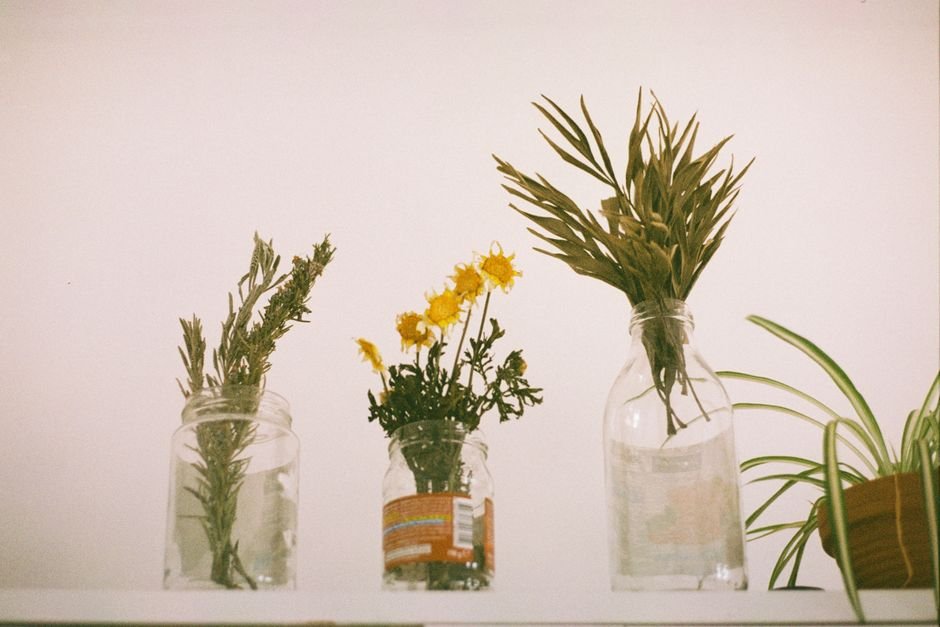
I have two arrangements going in my kitchen right now, a small bunch of sweet peas crammed into a jam jar on the windowsill and a much fuller mix in a big glass jug on the counter, and I built them in almost completely different ways even though I started with flowers from the same bucket.
Stem Count Changes Everything
A jam jar holds maybe five or six stems before it starts to feel crowded, so every stem I put in it matters individually. I’ll actually look at each one before it goes in, checking the bend, the length, whether the flower head is facing a direction I like, because there’s nowhere for a mediocre stem to hide in an arrangement that small. A big jug can hold twenty stems easily, and at that scale I stop evaluating each one on its own and start thinking in clumps instead, three ranunculus together here, a handful of greenery there. Individual stems matter far less when there are enough of them to blend into an overall shape.
The Narrow Neck Does the Work for You
One thing I appreciate about a jam jar is that the narrow opening holds stems upright without much help from me. I can drop flowers in almost at random and they’ll lean against each other and stay roughly where I put them because there just isn’t room to flop over. A wide jug offers no such help. Stems slide toward the edges and pool together on one side unless I’m deliberately crisscrossing them as I go to build some structure inside the vessel, which is a step I never have to think about with the jam jar.
What Goes Wrong at Each Size
The mistake I make most often with a jam jar is overfilling it, trying to fit in one more stem than it can actually hold because I don’t want to leave anything out of the bucket. Last week I did exactly that with a small bunch of ranunculus, added a seventh stem because I liked the color and didn’t want it going in the compost, and ended up with something so packed that half the flower heads were facing sideways into each other instead of outward. I had to pull two back out and put them in a small glass instead, which ended up looking better than the overstuffed jar would have.
With the big jug the mistake runs the other way. I’ll add stems until the shape looks full from the front, forget to keep turning it, and end up with something that looks generous from where I’m standing and thin and gappy from the side. A jug takes more flowers than I expect to actually fill out, and I’ve learned to buy a slightly bigger bunch than feels necessary whenever I know it’s going in the big vessel rather than a jar.
Height and Where They Sit in the Room
The jam jar almost always lives on the windowsill, low enough that it doesn’t need to do much visually beyond sitting there catching the morning light. I don’t worry about the back of it because nobody sees the back, it’s pushed against the glass. The big jug sits somewhere more central, the kitchen counter or occasionally the table if I’ve got the room that day, and because people walk around it, I do have to think about all sides, which is a completely different exercise from the jar’s one good angle.
Different Flowers Suit Different Sizes
I’ve started noticing that certain flowers just belong in one size over the other. Sweet peas, with their thin stems and slightly tumbling habit, look a little lost and swamped in a big jug, they need the closeness of a small jar to look purposeful rather than sparse. Ranunculus and anything with a bit more structure and a sturdier stem can hold their own in a bigger vessel without disappearing. I used to buy one bunch and split it evenly between whatever containers I had going that week, but now I think about which flowers are going where before I even get home, because putting the wrong flower in the wrong sized vessel is the fastest way to end up disappointed by an arrangement that should have worked.
Cleanup Is Different Too
Even taking them apart at the end is a different job. A dying jam jar arrangement is a two minute task, tip the water out, rinse the jar, compost five or six stems, done. The big jug takes considerably longer, because twenty stems means twenty individual judgment calls about whether a particular one still has another day or two left in it or whether it’s dragging the rest down and should come out now. More than once I’ve left the jug going a day too long because I couldn’t be bothered to sort through it stem by stem, and ended up with a slightly murky smell coming from the water that I only noticed once I was standing right next to it. The jam jar never gives me that problem, mostly because there’s so little in it that a single flower going over is obvious immediately.
Two Approaches, Same Bucket
What I like about keeping both going at once is that they force two different kinds of attention out of me in the same week. The jam jar makes me slow down and consider each stem. The jug makes me think about volume and balance and the whole shape at a wider distance. Neither one is the better skill to have, they’re just different muscles, and switching between them regularly has probably taught me more about arranging than sticking to one size ever would have.