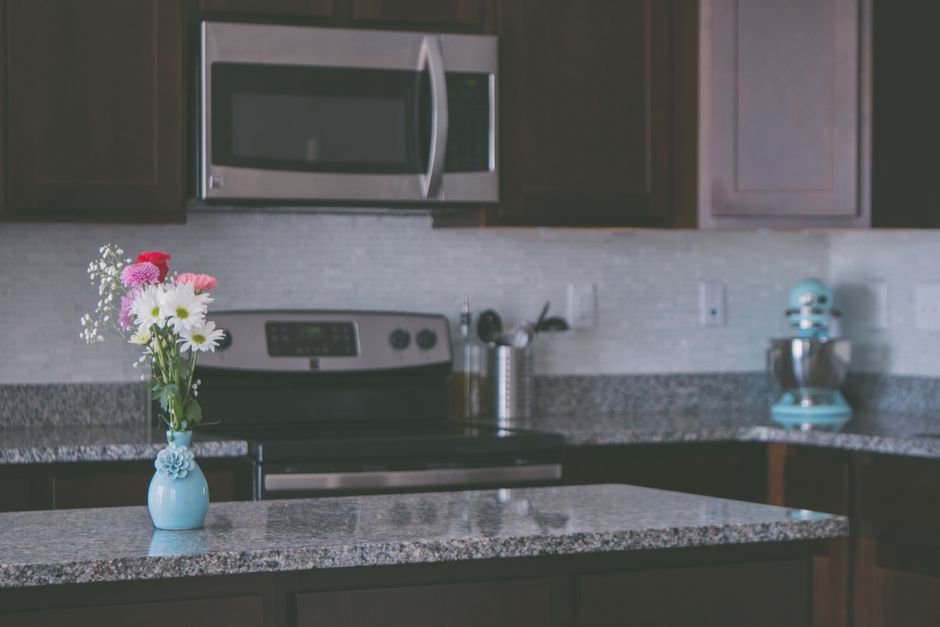
Somebody once asked me, looking at a jug of flowers on my counter, whether I’d used floral foam to get them to stand up like that, and I had to explain that no, I’d just shoved them in and hoped, which is more or less my entire approach to every rule I’ve read about arranging.
Floral Foam
I don’t use it, not because I have some principled objection to it but because I’ve never once needed it. The idea is that the foam gives you total control over where every stem points, which sounds appealing until you consider that I don’t actually want that much control. Half of what I like about my own arrangements comes from stems settling into positions I didn’t choose, leaning against each other, finding their own angle. Foam would take that away and replace it with the kind of precise, everything faces exactly where I put it look that, frankly, I tried once with the whole graduated height and odd stem count approach and didn’t enjoy the result. There’s also the plain fact that I’d have to buy it, store it, and remember to use it, and I already forget where I put the scissors half the time.
Wire and Tape
I own neither, and I’ve never felt the absence. Wire is for holding a stem in a shape it wouldn’t naturally hold on its own, straightening a bend or forcing an angle, and every time I’ve seen it explained it sounds like a lot of fuss for an effect I don’t particularly want anyway. If a stem has a natural bend, I’d usually rather work with the bend than correct it. Tape, similarly, is meant to bind a bunch into a fixed shape before it goes into the vessel, and I skip that step entirely because I like being able to adjust individual stems after they’re already sitting in the water, which you can’t easily do once everything’s been taped together into one rigid unit.
Odd Numbers of Stems
This is probably the rule I break most casually, mostly because I’ve never once counted my stems before putting them in a vase. I buy a bunch, I use most of it, sometimes I split it across two containers, and the number that ends up in each one is whatever it is. I did try counting deliberately once, landing on seven stems for the sake of following the rule, and ended up trimming perfectly fine stems to match a height pattern instead of just looking at what was in front of me. The arrangement that came out of that exercise was the stiffest, least alive looking thing I’d made in months. I’ve stuck to not counting ever since.
Stripping Every Leaf Below the Waterline
I do strip some leaves, mainly ones that are already wilting or ones that would sit directly in the water and start smelling within a couple of days, because that part of the advice is genuinely practical. But I don’t strip everything the way some guides suggest, taking every single leaf off every stem for a cleaner look. I like some greenery still attached, it softens the arrangement and stops it from looking like a bundle of bare sticks with flowers stuck on top. The full strip always looks a bit sparse to me, more like a display than something that grew.
Trimming at a Precise Angle
I trim my stems at an angle because it’s genuinely easier to push them into a vessel that way, not because I’m measuring anything or aiming for the specific forty five degrees that gets mentioned in every set of instructions I’ve come across. Some of my stems probably get cut at something closer to twenty degrees, some closer to sixty, depending on how the scissors happened to be sitting in my hand at the time. I’ve never noticed a difference in how long the flowers last, and I’ve stopped worrying about it.
Matching the Vessel to the Flower’s Formal Category
There’s a version of arranging advice that pairs specific flower types with specific vessel styles, tall spiky flowers in tall narrow vases, rounded soft flowers in wide bowls, that kind of thing. I ignore this completely and use whatever vessel is clean and available, which usually means a jam jar or a pitcher regardless of what’s actually in my hand that week. Some of my favorite arrangements have come from pairings the rule would never have suggested, delicate sweet peas crammed into a fairly heavy ceramic pitcher, or a big blowsy ranunculus head sitting almost too large for the narrow jam jar it ended up in. The mismatch is often what makes it look like it belongs in an actual kitchen instead of a photograph.
The One Rule I Actually Keep
Changing the water every couple of days is the single piece of standard advice I follow without any resistance, mostly because I’ve tested the alternative by accident more than once and regretted it. A jar left too long develops a faint, unpleasant smell long before the flowers themselves look bad, and once that happens no amount of rearranging fixes it. It’s such a small habit compared to everything else I ignore that it barely feels like a rule at all, just something I do on my way past the sink most mornings.
None of this is really about rejecting expertise. It’s that most of these rules are solving a problem I don’t have, getting flowers to hold a specific, controlled shape for a formal setting. What I want on my kitchen table is closer to what was already sitting on the shop counter, a little unruly, leaning where it wants to lean, and every rule I’ve dropped has gotten me closer to that instead of further away.