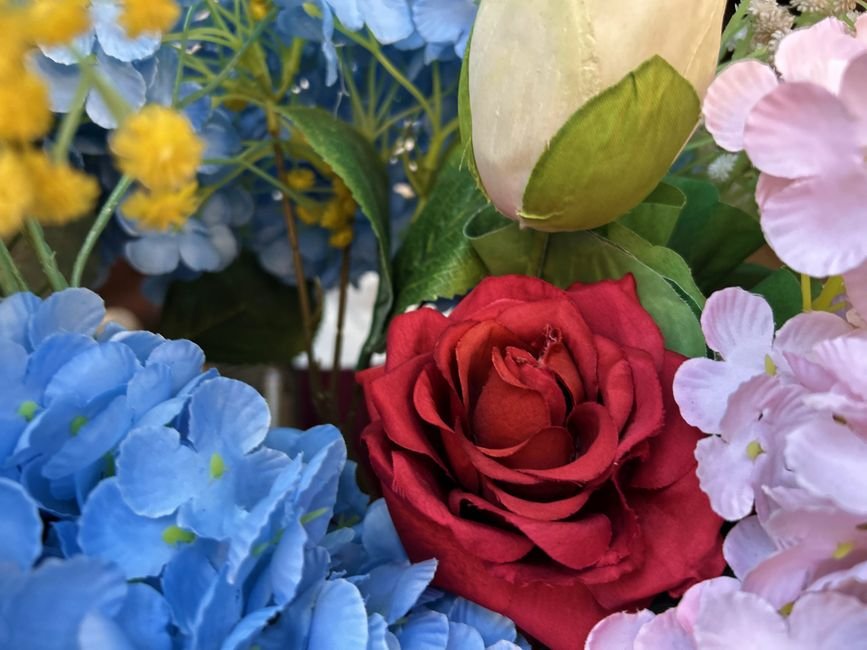
There’s a little cart near the registers at my grocery store where they wheel out flowers that didn’t sell in time, marked down and looking a bit tired under the fluorescent lights. For a long time I walked right past it, assuming discount meant not worth bothering with. Then one afternoon I picked up a sad looking bunch of yellow spray roses for almost nothing, brought them home, mixed them with a fuller bunch I’d bought that same trip, and ended up with an arrangement that looked better than either bunch would have on its own.
Why Clearance Stems Are Worth a Look
The stems on that discount cart aren’t usually ruined, they’re just past the point where they’ll sell at full price, often because a petal or two has browned or the bunch has thinned out from other shoppers pulling stems for themselves. Once I stopped judging the whole bunch by its worst stems and started looking stem by stem, I realized most bunches on that cart have at least a few perfectly good flowers hiding among the rough ones. Pulling just those good stems out and leaving the rest behind means I’m not paying for anything I won’t actually use.
How I Actually Combine Them
My approach is pretty simple. I buy one fuller, fresher bunch as the base of whatever I’m making, then I go through the clearance cart looking for individual stems, not whole bunches, that can fill in gaps or add a bit of contrast. A few gold or peach toned clearance stems tucked into a bunch of white or cream flowers can completely change the feel of an arrangement for barely any extra money. I treat the clearance stems as an accent rather than the main event, since they’re usually a little further along in their life than the fresher bunch and won’t hold up quite as long anyway.
The Mismatch I Didn’t See Coming
The first time I tried this seriously, I grabbed a handful of clearance carnations without paying attention to how far along they actually were compared to the fresh bunch I’d paired them with. Within three days, the clearance stems had wilted completely while the fresher bunch was still going strong, and I ended up with a vase that looked half full and a little uneven, like it had aged badly overnight. I hadn’t thought about the fact that mixing stems at different points in their life means they won’t fade evenly, which seems obvious now but genuinely caught me off guard that first time.
What I Do Differently Now
These days I try to pull out any clearance stems that look closer to the end before I even bring the arrangement home, trimming the vase down once those particular stems fade rather than leaving the whole thing to look patchy. I also pay more attention to matching the general condition of the clearance stems to the fresh bunch, rather than grabbing whatever color catches my eye. If a clearance stem still has firm petals and a sturdy stem, even if it’s a bit less than perfect looking, it tends to blend in fine. If it’s already dropping petals in the store, I leave it on the cart no matter how cheap it is.
Why This Has Become a Habit
Part of what I like about mixing in clearance stems is that it forces me to actually look closely at individual flowers instead of buying a whole prepackaged bunch and trusting it blindly. It’s slowed me down in a good way. I’ve also noticed my kitchen windowsill vase gets refreshed more often now, because grabbing a few clearance stems on a normal grocery run costs so little that I don’t feel like I need a special occasion to do it. It’s turned buying flowers into something a bit more like a small treasure hunt on an otherwise boring errand.
What I Look for on the Clearance Cart Now
These days I go through the clearance cart with a specific routine rather than just grabbing whatever looks colorful. I check the stem ends the same way I would on a full price bunch, I press gently to feel for firmness, and I skip anything with a strong smell coming off the bucket water, since that’s usually a sign the whole cart has been sitting for a while. I also try to buy odd numbers of clearance stems rather than whatever’s left over, since three or five stems tend to sit more naturally alongside a fuller bunch than an awkward even number does. None of this takes long once it’s a habit, maybe an extra two or three minutes at most, but it’s made the difference between clearance stems that genuinely add something to an arrangement and ones that just quietly drag the whole vase down early.
A Small Note on Expectations
I don’t expect an arrangement built partly from clearance stems to last as long as one made entirely from a fresh bunch, and I’ve made my peace with that. Some of it will fade a day or two earlier than the rest, and I just pull those stems as they go rather than treating the whole vase as one unit with one lifespan. Once I stopped expecting every stem to age at the same pace, the whole habit got a lot less frustrating and a lot more just quietly practical.