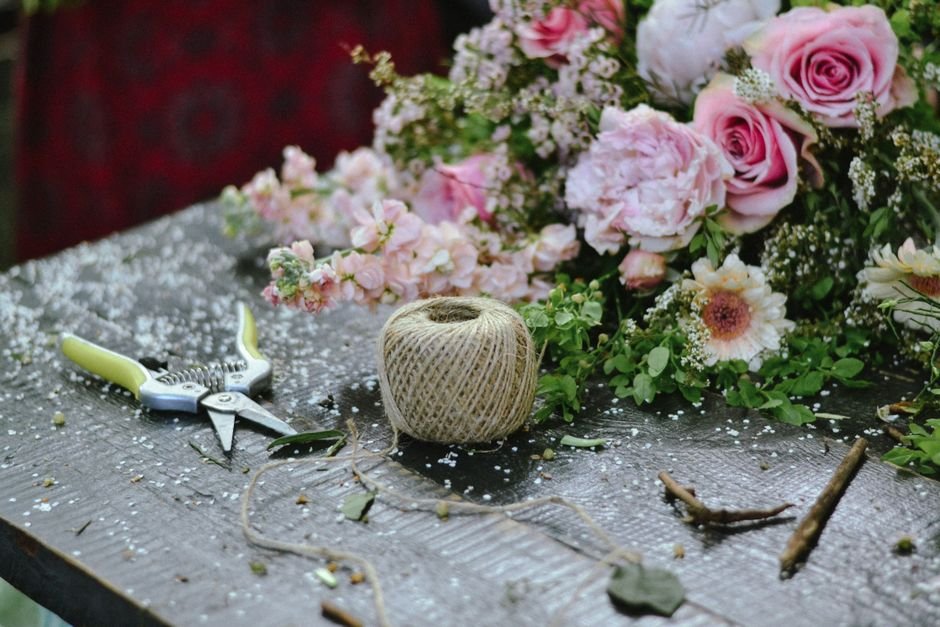
Tuesday evening, my kitchen table is covered in yesterday’s newspaper because I never remember to buy the plastic sheeting people use, and there’s a bucket of stems still wearing their rubber band sitting in the sink while I hunt for scissors that I know are somewhere in the utensil drawer, wedged behind a whisk I never use. This is how almost every arrangement starts for me now: not with a plan, but with me standing over a pile of flowers wondering where I put the good scissors.
I Don’t Sort First
Every method I’ve read about starts the same way. Sort your flowers by type. Strip the leaves. Cut at an angle. Group your focal flowers, your filler, your greenery, like you’re prepping ingredients for a recipe. I tried that exactly once, laid everything out on a towel in neat little rows, and by the time I’d sorted it all I had lost interest in actually putting anything together. The flowers had been out of water for twenty minutes and some of the ranunculus had already started to droop at the neck.
Now I just reach into the bucket, pull out whatever my hand lands on, and start. If it’s a big floppy stem, it usually goes in first because it needs the most room. If it’s something small and stiff, it waits. I’m not deciding in advance what the finished thing will look like. I’m deciding one stem at a time, which sounds like it would take longer, but it’s actually faster, because I’m not stopping to consult a plan that I would probably abandon anyway.
I Build From the Middle, Not the Outside
A lot of the arranging guides I’ve flicked through tell you to build your outline first, a loose dome of greenery that sets the shape, and then fill in toward the center. I do the opposite. I put my favorite flower, usually whatever has the strongest color that week, right in the middle of the vessel first, low, so it’s basically sitting at the rim. Everything else gets built up and around it. It means my arrangements often lean a little lopsided, heavier on one side than the other, but I’ve stopped minding. A vase on a kitchen table gets looked at from one angle most of the time anyway, from wherever you’re sitting with your coffee.
I Turn the Vase Constantly
This is probably the only genuinely useful habit I have. I spin the vessel a quarter turn after almost every stem goes in, so I’m never building one whole side and then discovering the back is bald and the front is overcrowded. I learned this the hard way early on, when I made what I thought was a beautiful arrangement, stepped back, and realized I’d been staring at the same three inches of it the entire time. The side facing the wall had two stems total and a lot of visible glass.
I Let the Flowers Argue With Me
Some stems just will not go where I want them to go. A tulip will bend toward the window no matter how I turn the vase, or a stem will be too short for the spot I had in mind for it. For a long time I fought this, trimming and repositioning and getting frustrated. Now I mostly let the flower win. If a tulip wants to lean, I let it lean and build the rest of the arrangement to make that lean look intentional instead of trying to force it upright. Half of what looks like a relaxed, natural arrangement in my kitchen is really just me giving up on a stem and calling it a design choice.
The Mess Is Part of It
By the time I’m done there are leaves all over the table, water rings on the newspaper, and usually a stem or two on the floor that I only find later, dried out, when I’m sweeping. I used to think a proper arranger would be tidier than this, working cleanly the way people do in videos where the table stays spotless and every trimming lands directly in a small bowl. Mine has never looked like that. I’ve made peace with the fact that a good result and a tidy process are not the same thing, at least not for me.
Knowing When to Stop
The part I still get wrong most often is stopping too late. I’ll have something that looks good, genuinely good, and then I’ll decide it needs one more stem, and that one stem throws off the balance I’d already found. Last month I did this with a jug of ranunculus and sweet peas that looked full and soft and exactly right, and I added two more ranunculus because the bucket still had them and it felt wasteful not to use them. The result was crowded, stiff looking, like I’d shoved in extra guests at a table that was already comfortably full. I had to pull two stems back out and by then they’d been handled so much they never quite recovered their shape.
These days I try to put my scissors down the moment something looks finished, even if it means walking away from flowers still sitting in the bucket. They usually end up in a small jar on the windowsill the next morning anyway, so nothing goes to waste. It just means two vases instead of one overstuffed one, which is honestly usually the better outcome.